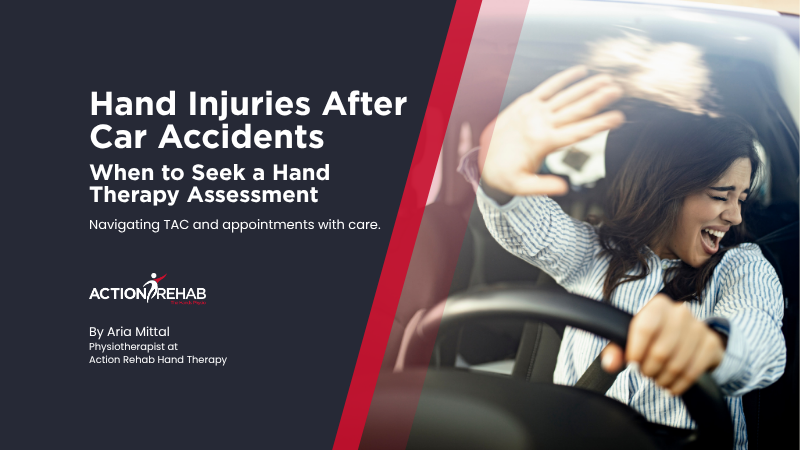
Summer and the holiday period often bring road trips, family visits and more time travelling.
In its December 2025 holiday campaign, the Transport Accident Commission (TAC) reminded Victorians that roads would be busy and highlighted the risks of speeding and drink driving. Hand and wrist injuries are another aspect of road trauma worth understanding.
When we think about injuries following a car accident, we often think about the neck, back, legs or more serious injuries. However, the hands and wrists can also be affected by the forces involved in a crash. These injuries may sometimes be overlooked, particularly when there are other injuries that require more immediate attention.
At Action Rehab, we see people recovering from a range of hand and upper limb injuries following transport accidents. Understanding what can happen to the hands and knowing when to seek assessment can help support recovery.
How can a car accident injure your hands?
During a collision, the hands can be exposed to considerable force. You might grip the steering wheel tightly, brace yourself against the dashboard or instinctively put your hands out to protect yourself. Sudden impact, twisting or compression can injure the bones, joints and soft tissues of the hand and wrist.
Common injuries can include:
- Fractures: Broken bones in the fingers, hand or wrist.
- Ligament injuries: Stretching or tearing of the ligaments that support and stabilise the joints.
- Tendon injuries: Damage to the tendons that help you bend and straighten your fingers and wrist.
- Nerve injuries: Irritation or damage that may cause numbness, tingling or weakness.
- Soft tissue injuries: Muscles, tendons and other soft tissues can be bruised or strained even when there is no fracture.
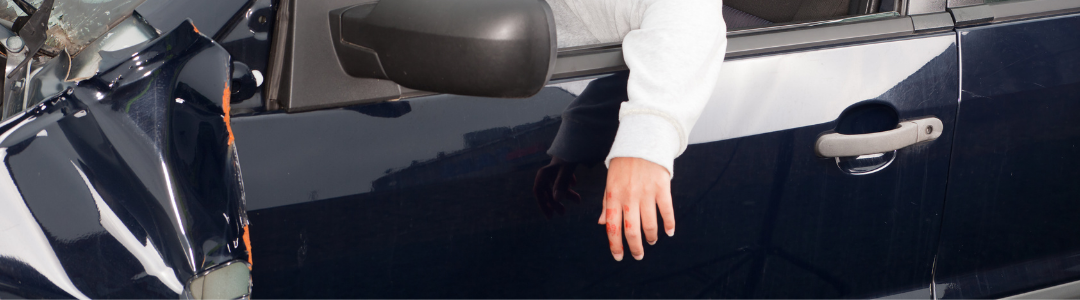
The Australian Institute of Health and Welfare reported that the wrist and hand were among the three most frequently injured body regions presenting to emergency departments in Australia in 2024–25.
Why might a hand injury be missed?
Immediately after a car accident, it is understandable that the hands may not be your main concern. Pain from other injuries, adrenaline and the stress of the accident can make it difficult to notice every symptom.
Some hand injuries can also initially appear relatively mild. A person may have only a small amount of pain but develop increasing swelling, stiffness or difficulty using the hand over the following days.
Seek medical assessment if you have difficulty moving a finger or wrist, reduced grip strength, numbness or tingling, difficulty using your hand normally, or persistent pain or swelling. You do not need to wait for every symptom to develop before seeking advice.
A hand injury does not necessarily need to be extremely painful to require assessment.
When is emergency care needed?
Hand therapy is not a substitute for emergency medical assessment after a car accident. Seek urgent emergency care if a limb is visibly bent or twisted or bone is exposed.
Call 000 for an ambulance if you have difficulty breathing or feel confused after a head injury. Do not wait for a routine hand therapy appointment in these circumstances.
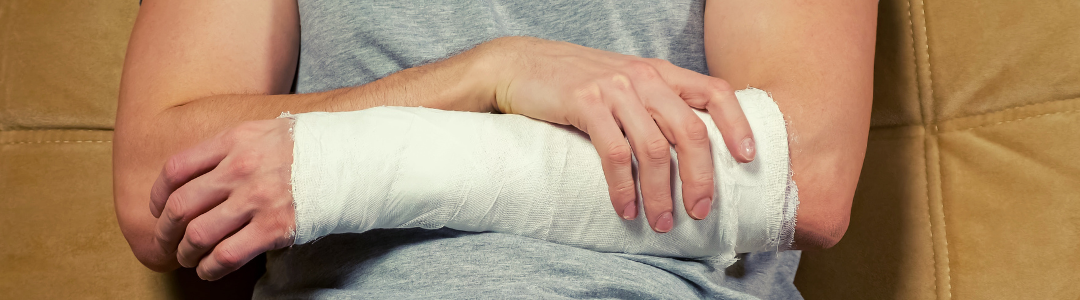
How can hand therapy help?
Treatment will depend on the specific injury, the structures involved and the stage of healing. Your hand therapist may use a combination of the following:
Splinting and protection
Some injuries require temporary protection while the tissues heal. A hand therapist can assess whether a splint is appropriate and fabricate a custom splint to protect the injured area. The timing of splint use is important. Some injuries require more protection initially, while others benefit from early movement. Your therapist will guide you on when and how to use your splint.
Managing swelling and stiffness
Swelling can make it difficult to move the fingers and wrist normally. It can also contribute to stiffness and make everyday activities more difficult. Your therapist can provide strategies to manage swelling and safely restore movement
Restoring strength
After an injury, grip and hand strength may decrease due to pain, swelling, or reduced use. Strengthening exercises are generally introduced gradually and should be appropriate for the injury and stage of healing. Your hand therapist can help you progress these exercises safely.
Returning to normal activities
Recovery is not just about reducing pain: hand therapy is guided by the activities that matter to you. These might include work, driving, sport, lifting, cooking, household activities or caring for your family. Your therapist can help you gradually increase the demands placed on your hand while considering your symptoms and recovery.
Returning to these activities is a rehabilitation goal, not a guaranteed outcome; progress depends on your injury and stage of healing.
What if my injury is covered by the TAC?*
If you have sustained a hand or upper limb injury as a result of a transport accident in Victoria, you may be eligible for treatment funded by the Transport Accident Commission.
The TAC recognises hand therapy as a treatment service for eligible transport accident injuries. Hand therapists can assess and treat injuries affecting the fingers, hands, wrists, elbows and shoulders, with treatment aimed at helping people return to optimal function following trauma or surgery.
In the first 90 days after your accident, the TAC can help pay for hand therapy without prior contact for approval if you have a TAC claim number, a doctor or other health professional recommends the treatment, and it is for your accident injuries. Contact the TAC if it is close to or more than 90 days since the accident and further treatment has not already been approved, or if more than six months have passed since any TAC-funded treatment or service. Ask your provider about fees before your appointment: a gap payment may apply if their fee exceeds the TAC rate*.
TAC funded hand therapy can include assessment, treatment, exercise based rehabilitation, education, splinting and equipment prescription.
Looking after your hands after an accident
If you are involved in a car accident, your hands may not be your first concern. However, if you notice ongoing pain, swelling, stiffness, weakness, numbness or difficulty using your hand, it is worth getting it assessed.
Early assessment can help identify injuries and ensure that the appropriate treatment and rehabilitation are provided.
At Action Rehab, our hand therapists assess and treat a range of hand and upper limb injuries following trauma, including transport accident injuries. Our goal is to help you recover movement, strength and function so you can return to the activities that matter to you.
Commonly Asked Questions
Can a car accident cause hand or wrist injuries?
Yes. During a collision, the hands and wrists may be exposed to sudden forces that can lead to fractures, ligament injuries, tendon injuries, nerve injuries or soft tissue damage.
When should I see a hand therapist after a car accident?
Consider seeking assessment if you experience ongoing pain, swelling, stiffness, weakness, reduced grip strength, numbness or difficulty using your hand normally.
Does TAC cover hand therapy?
Eligible Victorian transport accident claimants may be able to access funded hand therapy services through the TAC.
Can hand therapy help after a wrist fracture?
Hand therapy may assist with recovery by addressing swelling, stiffness, strength and functional movement following injury.
References
Transport Accident Commission. Encouraging safer driver behaviour this holiday season. Victorian Government, 2025. https://www.tac.vic.gov.au/about-the-tac/media-room/news-and-events/2025/encouraging-safer-driver-behaviour-this-holiday-season?
Transport Accident Commission. Hand therapy. Victorian Government. https://www.tac.vic.gov.au/clients/how-we-can-help/treatments-and-services/services/hand-therapy?
Australian Institute of Health and Welfare. Injury in Australia – Body parts injured. Australian Government, 2026. https://www.aihw.gov.au/reports/injury/injury-in-australia/contents/body-parts-injured?
*Accurate at the time of post, always refer to the TAC for the most up to date information.
Author
-
 View all posts Physiotherapist
Aria Mittal is a physiotherapist focusing on hand, wrist, elbow and shoulder injuries at Action Rehab hand therapy. She takes a practical, patient-centred approach to help people get back to work, sport and everyday activities. Aria enjoys tailoring rehab programs to each person and keeps up to date with the latest in upper limb care. Available for appointments in Melbourne's South-East, she can treat in English and Hindi.