

Tennis elbow, also known as lateral epicondylitis, affects around 1-3% of the Australian population each year, predominantly in people aged 35-50 years old1.
However, despite its name, tennis elbow is rarely seen in actual tennis players. Studies show that only an estimated 10% of individuals who have tennis elbow, actually play tennis2.
Tennis elbow is a condition that affects tendons of the forearm that originate in the common extensor origin, located on the lateral epicondyle of the elbow, and pass through into the wrist.

Anatomy involved in tennis elbow including relevany bony landmarks and tendons. Tennis Elbow (Lateral Epicondylitis) – OrthoInfo – AAOS Reproduced and modified from The Body Almanac. © American Academy of Orthopaedic Surgeons, 2003.
The tendons affected include the extensor carpi radialis brevis, extensor carpi radialis longus, extensor digitorum communis, extensor digiti minimi and extensor carpi ulnaris. These tendons primarily act to extend the wrist, rather than move the elbow.
Clinically, tennis elbow presents as inflammation, degeneration or tears depending on the progression of the injury. This causes pain on the outside part of the elbow, particularly with wrist extension and rotation of the forearm.
If not tennis, what causes Tennis Elbow?
Another common misconception with tennis elbow is that it is directly related to elbow use.
However, tennis elbow primarily results from repetitive wrist extension.
The tendons mentioned above involved in tennis elbow function to extend the wrist, and thus are stressed too much with repetitive and loaded wrist extension.
Pronation and supination (rotating of the forearm) are also associated with tennis elbow. This repetitive loading of the tendons causes inflammation and over time, can cause tears or degeneration.
Tennis elbow is most often caused by work, specifically jobs which involve handling tools over 1kg, handling loads over 20kg at least 10 times a day or repetitive movements for more than 2 hours a day3.
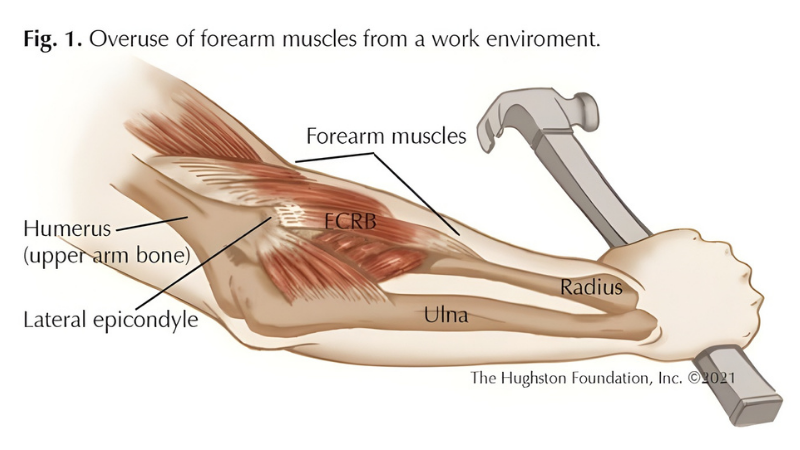
Example of work which can cause overload of forearm extensor muscles, thus causing tennis elbow (Hughston Clinic, 2025 https://hughston.com/wellness/lateral-epicondylitis-tennis-elbow/)
What do I do if I think I have Tennis Elbow?
Tennis elbow requires physical assessment and diagnosis by a hand therapist – good thing we have one or two of those at Action Rehab!
Our trained occupational therapists and physiotherapists will complete a thorough examination including physical assessment, background history and any relevant scans.
Once a diagnosis is confirmed, we treat tennis elbow with a thermoplastic wrist splint. The purpose of the wrist splint is to stop a person from extending their wrist, allowing the overloaded wrist extensor tendons at the elbow to rest.
Once your symptoms are better managed, we prescribe a gradual strengthening program which has been shown to improve tendon health and provide symptomatic relief4.
Our goal at Action Rehab is to help you recover quickly so you can get back to doing the things you love and whatever is important to you.
And if you are a tennis player with a sore elbow – stay tuned for more information about what may be happening with your elbow. It might be tennis elbow… or it might not!
References
- Johns, N. & Shridhar, V. (2020). Lateral epicondylitis: Current Concepts. https://www1.racgp.org.au/ajgp/2020/november/lateral-epicondylitis
- Priest, J.D., Braden, V. & Gerberich, S.G. (2016). The Elbow and Tennis, Part 1: An Analysis of Players With and Without Pain. https://www.tandfonline.com/doi/epdf/10.1080/00913847.1980.11710917?needAccess=true
- Rijn, R.M., Huisstede, B. M.A., Koes, B.W., & Burdorf, A. (2009). Associations between work-related factors and specific disorders at the elbow: a systematic literature review https://pubmed.ncbi.nlm.nih.gov/19224937/
- Page, P. (2010). A New Exercise for Tennis Elbow that Works! https://pmc.ncbi.nlm.nih.gov/articles/PMC2971639/pdf/najspt-05-189.pdf

Rhyannah Hammer
How can I have Tennis Elbow if I don’t play Tennis?
Discover what causes tennis elbow, why it’s not just for tennis players, and how Action Rehab helps with diagnosis and recovery. Help for elbow pain


The importance of eccentric and isometric exercise in the treatment of tennis elbow
Home » The


Authors
- View all posts Occupational Therapist
Rhyannah graduated with a Bachelor of Science in Human Biology and Science Communication from the Australian National University, then earned a Master of Occupational Therapy from the University of Canberra. She has clinical experience in occupational rehabilitation and community care, with a passion for hand therapy stemming from her interest in upper limb anatomy. Rhyannah focuses on helping patients return to pre-injury activities and keeps updated on hand therapy research for customised rehabilitation programs. Outside work, she plays tennis socially and competitively, inspired by her childhood. She currently works at Action Rehab, assisting those with upper limb injuries.
-