
The shoulder is a very mobile but instable joint which allows for a wide range of motion in the arm (Maruvada et al., 2017). The shoulder joint is also called the glenohumeral joint, where the head of the humerus fits into a cavity on the scapula. The shoulder’s range of motion is due to its ball-and-socket structure, which permits movements such as raising the arm, rotating it, and extending it in different directions (Maruvada et al., 2017).
This joint is surrounded by various muscles and tendons that help to stabilise the shoulder. The rotator cuff is just one of these important structures that help to stabilise the glenohumeral joint.
The rotator cuff muscles arise from the scapula and connect to the head of the humerus, forming a cuff around the glenohumeral joint (Maruvada et al., 2017). These muscles include the supraspinatus, infraspinatus, teres minor and subscapularis. These muscles work together to provide strength and stability for shoulder movements (Maruvada et al., 2017).
Supraspinatus muscle tears are the most common rotator cuff injuries (Zhao et al., 2021). The supraspinatus assists in abduction of the shoulder, stabilisation, control and movement of the shoulder and preventing subluxation at the shoulder.
Supraspinatus tears normally present as partial or full-thickness tears. They can be asymptomatic (not painful) or symptomatic (painful). Up to 46% of patients with partial or full thickness tears are asymptomatic and this tends to be more common in older adults (Lawrence et al., 2019).
A supraspinatus tear can occur from trauma, falling on an outstretched arm or lifting something too heavy. Or it may occur from degenerative wear and tear of the muscle. This tear usually affects the dominant arm and is associated more commonly with older patients.
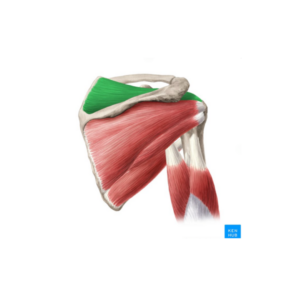
Pain is often experienced in over head motions, reaching behind the back or lifting heavy items. Usually there is discomfort and pain when sleeping and the top of the shoulder may be sore to touch.
Our role is to work with you (and your surgeon, if applicable) to develop a tailored therapy plan, reduce pain symptoms & functional limitations and ultimately ensure you can participate in the activities that are meaningful to you by regaining optimal function of the shoulder.
References
Lawrence, R. L., Moutzouros, V., & Bey, M. J. (2019). Asymptomatic rotator cuff tears.JBJS reviews,7(6), e9. https://doi.org/10.2106/JBJS.RVW.18.00149
Maruvada, S., Madrazo-Ibarra, A., & Varacallo, M. (2017). Anatomy, rotator cuff. In: StatPearls. StatPearls Publishing, Treasure Island (FL); 2023. PMID: 28722874.
Zhao, J., Luo, M., Liang, G., Wu, M., Pan, J., Zeng, L. F., … & Liu, J. (2021). Risk factors for supraspinatus tears: a meta-analysis of observational studies.Orthopaedic journal of sports medicine,9(10), 23259671211042826. https://journals.sagepub.com/doi/10.1177/23259671211042826