

Ganglion Cyst of the Wrist and Hand
Pathophysiology:
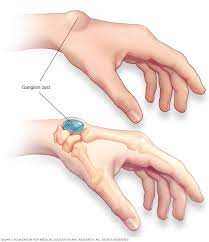
Ganglion cyst is the most common mass of the hand, and when present at the dorsum of the wrist around the scapholunate interval, there is little doubt of the diagnosis. When this mass occurs in other locations or is multiloculated, the diagnosis may be less obvious. Generically, ganglion cysts arise from joints, tendons, bursae, or ligaments. This may be due to degenerative or posttraumatic attenuation of a joint capsule or tendon sheath causing expansion of a fluid-filled capsular sac.The vast majority of wrist ganglions present as atraumatic, slow-growing, painless masses, with over 70% located on the dorsal wrist and approximately 20% located on the volar wrist.Men are affected slightly more often than women. Most patients are between the fourth and sixth decades of life.Although patients are often asymptomatic, pain or a palpable lesion is occasionally present.
Symptoms:
Most ganglion cysts show up as a soft bump or mass that changes size but doesn’t move. They’re often painless. Swelling may appear over time or suddenly. Other symptoms of a ganglion cyst include:
· A bump that goes away and comes back
· One large cyst or many smaller cysts
· Some degree of pain, especially after an injury or trauma from repeated movement
· Long-lasting pain that gets worse when you move the affected joint
· Pressure on nerves that causes tingling or numbness
· Weakness in the affected finger if the cyst is connected to a tendon
Causes:
It’s not clear what causes ganglion cysts to form, but there is some evidence that they may be related to prior trauma or arthritis.
Diagnosis and Test:
If you have a ganglion cyst, your doctor may ask you to have an X-ray to determine whether there are other problems in nearby joints. Sometimes, an MRI can show a ganglion cyst that is not visible on an X-ray.
Management:
Conservative management includes: anti inflamatory medications, splinting and brace and sometimes aspiration where your provider uses a needle to remove fluid from the cyst. Providers usually do aspiration in their office. You may feel better right away.
When to consider surgery?: if other treatments don’t provide relief or your cyst comes back. Surgeons treat ganglia by removing the entire cyst. A cyst often includes a stalk-like structure (root) attached to the cyst. Ganglion cyst removal surgery is called ganglionectomy. It’s usually an outpatient procedure. That means you should get to go home the day of surgery. Full recovery takes two to six weeks. Orthopaedic surgeons receive specialized training to perform intricate procedures on your body’s joints and other soft tissues.
Summary:
Ganglion cysts are benign, which means these lumps aren’t cancer. They pose no long-term threat to your health. Many ganglion cysts go away on their own. If a ganglion cyst affects your quality of life in any way, ask your provider about treatment options. Splints, over-the-counter pain medication or surgery may provide relief.
Reference:
Matthew W. Colman MD, … Mark Gebhardt MD, in Orthopedic Clinics of North America, 2014
Kareem Hassan, Patrick L. Reavey, in Plastic Surgery – Principles and Practice, 2022
J. Grant Thomson, MD, director of Yale Medicine’s Hand & Microsurgery Program.
American Academy of Orthopaedic Surgeons. Ganglion Cyst of the Wrist and Hand
American College of Foot and Ankle Surgeons. Ganglion Cyst
American Society for Surgery of the Hand. Ganglion Cyst
Merck Manual (Consumer Version). Ganglia )