
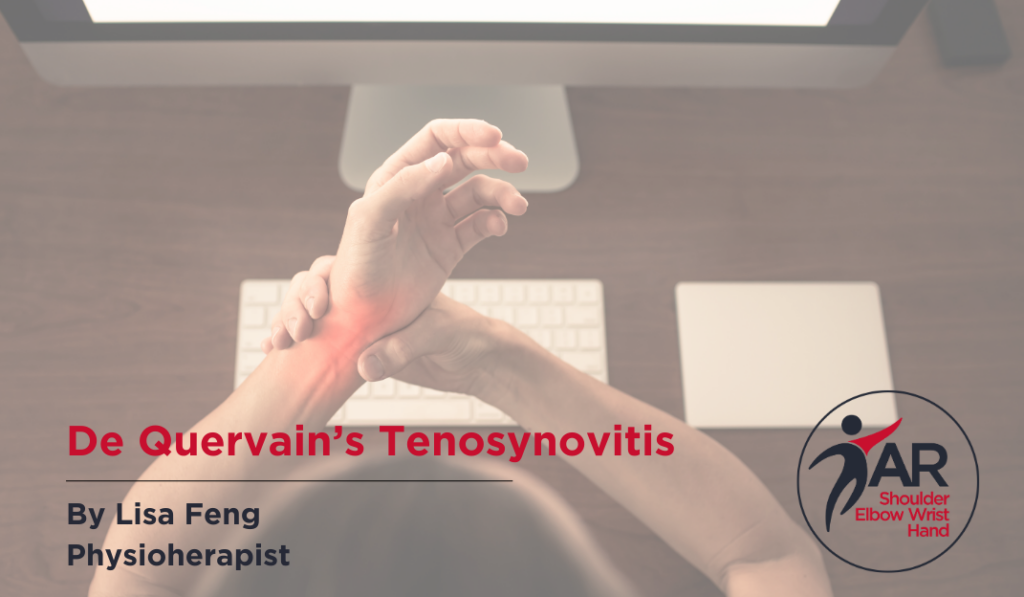
De Quervain’s Tenosynovitis (DQV) is a painful, inflammatory condition caused by tendons on the thumb side of the wrist. Specifically, these are the extensor pollicis brevis (EPB) tendon and the abductor pollicis longus (APL) tendon. The pain is aggravated by movements such as the grasping of the hand, abduction of the thumb and ulnar deviation of the wrist.
The most common causes of DQV include:
- Chronic overuse of the hand from work
- Activities that involve heavy use of the hand and wrist such as: golfing, playing instruments, carpentry, fly fishing etc.
- Very common in new mothers who are repeatedly lifting their new born babies with their thumbs stretched out in abduction and wrist in ulnar deviation.
- Direct trauma to the area
- Underlying inflammatory conditions such as osteoarthritis and rheumatoid arthritis.
Assessment:
To ensure that De Quervain’s Tenosynovitis is correctly assessed, your hand therapist will conduct a thorough subjective and objective history, a physical examination and special tests such as the finkelstein’s test. In some cases, an ultrasound may be warranted to confirm directly the presence of inflammation of the APL and EPB tendons.
Common symptoms:
- Pain or tenderness over the base of the thumb and/or first dorsal compartment extensor tendons on the thumb side of the wrist upon palpation.
- palpable/visible swelling in the anatomical snuffbox.
- Reduced carpometacarpal abduction range of motion of the thumb.
- Weakness in the hand
- Positive finkelstein’s test.
Treatment:
There are three tiers of treatment for DQV.
Tier 1 – Conservative management
This may include treatment modalities such as:
- Splinting
- Activity modification as advised by your hand therapist
- Your hand therapist may work with you on exercises to strengthen around the wrist to increase stability of the wrist and reduce pain.
- Kinesio-taping to reduce pain and facilitate better functional movement of the thumb.
- Massage
Tier 2 – Medication
- Your general practitioner may prescribe anti-inflammatory medication to reduce pain.
- Ultrasound guided cortisone injection may also be a treatment option for DQV that doesn not respond well to the previous treatment options.
Tier 3 – Surgery
For severe cases of debilitating DQV that does not respond to conservative management or medication. Surgery may be performed to release the 1st dorsal compartment. Your hand therapist will guide you through rehabilitation of the hand post surgery to achieve maximum outcomes.
References:
- Satteson E, Tannan SC. De Quervain Tenosynovitis. StatPearls [Internet]. 2021 Aug 8.
- Kate Thorn. De Quervain’s Tenosynovitis. Plus Course. 2021
- Katechia D, Gujral S. De Quervain’s tenosynovitis. InnovAiT. 2017 Sep;10(9):505-9.
Read more: De Quervain’s Tenosynovitis