
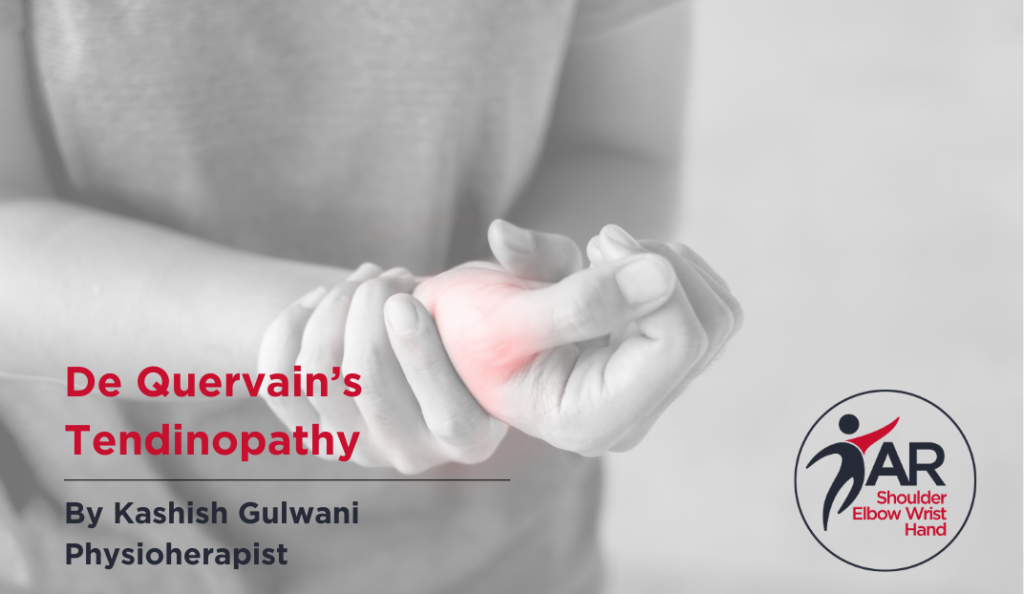
What is De Quervain’s tendinopathy?
De Quervain’s tendinopathy is inflammation of a sheath through which tendons of the wrist and thumb pass through. It can arise from repetitive overuse of the thumb as well as wrist instability, leading to inflammation which limits gliding of the tendons.
This can result in high levels of pain at rest and with movement and affect your daily function, a condition commonly seen in new mothers, office workers and manual laborers.
Symptoms can include:
- Pain near posterior base of the thumb, which may radiate up the forearm
- Swelling around the wrist
- Worsening pain with thumb and wrist movements especially sideways movement of the wrist
- Reduced wrist movement
- Pain with gripping tasks and thumb movements
Management:
Management of De Quervain’s tendinopathy depends on various factors including
- Severity and duration of symptoms
- Underlying cause
- Age
- Patient specific factors
Treatment options for De Quervain’s tendinopathy
Treatment can range from conservative to surgical management.
Conservative management usually consists of a mix of different therapies including fabricating a wrist and thumb immobilisation splint, work and daily activity modifications, manual therapy and therapeutic exercises.
Initially, to help reduce inflammation it is recommended to use a long thumb spica splint to immobilize your wrist and thumb. In addition to splinting, it is important to consider modifications to work and daily activities to assist with your treatment.
Once inflammation is managed, it is beneficial to commence therapeutic exercises to assist in strengthening and preventing recurrence of the condition.
Non-conservative intervention can include treatment modalities such corticosteroid injections and sheath release surgeries. To determine the best treatment plan, it is important to be assessed and treated by a hand therapist.
Author
-
 View all posts Physiotherapist
Kashish Gulwani graduated from the Australian Catholic University with a Bachelor of Physiotherapy.
During University, Kash studied a variety of health-related fields including human anatomy and biomechanics. She also has clinical experience working in hospitals with post-surgical patients, leading clinical Pilates classes and sports training in both adult and paediatric populations. Whilst studying, Kash also dedicated her time working with football and soccer clubs where she developed her interest in injury prevention and management.